|

Introduction
.
Page 1
.
Page 2
.
Page 3
The following historical account of the Institute is based on a document compiled in 1981 by a S. Swain.
This document had been compiled from various sources including;
documents, newspaper cuttings, and manuscript notes made by Mr Kenneth Gibbons, first secretary/treasurer of the management committee and later a trustee;
documents in the J.N. Fear Institute Deed Box by courtesy of Mr W. Bowes-Taylor, solicitor and trustee;
minute books from 27th January 1948 to 1981; and from information supplied by Mr B. Ivor Day, architect to the institute.
The text on the following pages has been condensed from that original document.
Next Page >>>
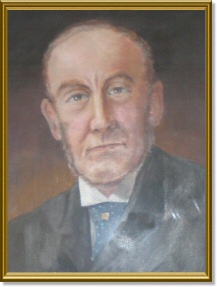 The donor of the Institute, John Nelson Fear, was born on 2nd August 1839 and died on 18th May 1917. He is buried in the family grave near the chapel in Keynsham Cemetery and in accordance with his wishes his trustees erected a tombstone to his memory.
Little is known of Mr Fear's earlier life, but the certificate of his marriage on 7th July 1862 to Sarah Ann Baker at the parish church at Walcot Somerset shows that at that time he was a plumber and glazier, son of Samuel Fear, also a plumber and that his wife was the daughter of Thomas Baker, a victualler. In later life he became Secretary to the Keynsham Gas Co. Ltd. whose premises were in Dapps Hill Keynsham, and also clerk to the Keynsham Parish Council, he resided at 4 The Avenue, Keynsham.
He was a typical Victorian gentleman with strong religious convictions especially in connection with intoxicating liquor and gambling. Both he and his wife were members of the Victoria Methodist Church to which Mrs Fear in her Will made in 1918 after the death of her husband gave a legacy of œ25. He had a special interest in the welfare of young people being leader of a bible class for young men.
At the official opening of the Institute the Chairman of the Trustees, Mr C H Abbott, spoke of Mr Fear as he had known him personally. Mr Fear, he said, was a man of strong character, outspoken and exceedingly tenacious. With his voluntary duties and his public work, Mr Abbott contended Mr Fear had touched all spheres of village activity. Cricket had typified his life and had demonstrated that he was neither spectacular nor brilliant, but a man of integrity and a plodder - when he played cricket he was a 'stone-waller'. He never hit a boundary, and his score mounted by ones and twos. He was rarely bowled but generally caught.
In his Will, made on 14th February 1917, after making specific personal gifts to his wife, he bequeathed the residue of his real and personal estate, except his house and premises in High Street, to his Trustees on Trust for his wife during her lifetime. After her death the estate was to pay various personal legacies including a sum to provide fire places in bedrooms and general improvements to the six Almshouses at Keynsham, and the remainder to pay and apply the same in founding, establishing, and providing furnishing and equipping premises in the Parish of Keynsham in the name of J.N. Fear Institute to be used in perpetuity for the purpose of reading, entertainment, and meeting in recreation rooms, and a club for the use of residents in the Parish of Keynsham and otherwise for the benefit and enjoyment of inhabitants of the said Parish, provided that the Institute should not be used for any political purpose whatsoever.
He directed his trustees "to apply for sanction to retain my house and garden and premises in the High Street Keynsham now in occupation of Charles Williams in order that the same may be utilised and employed as the premises for "The Institute" and which from their situation and otherwise I consider most suitable for the purpose". This was No. 30 High Street. (The adjoining property No. 32 was also retained by the trustees with the intention at a later date to enlarge the institute but circumstances did not permit this and in 1955 it was sold).
Next Page >>>
Due to the legal rights of the existing tenant of No. 30 High Street it was not until 4th December 1925 the charity Commissioners made a further order that the premises could be retained for the purpose of the charity
The Trustees appointed C G Lawrence & Co. of Bristol as architects for the Institute. Several plans were produced by them but the Trustees were faced with a dilemma of either building a cheap hall or investing the money to obtain more capital with which to build a more appropriate structure at a later date. They decided to take the latter course and so it was not until 1935 that the building of the new Institute building commenced.
The Constitution and Rules were finalised and adopted by the Trustees at the time, Charles Henry Abbot, Francis Gerald Whittuck, Charles Richard Willoughby, George Edwin Chappell and Claude Charles Harrison, on 25th January 1937. Under the constitution the management of the Institute was entrusted to four trustees and 12 members, four to be appointed by the Trustees and eight to be elected by ballot at the first annual general meeting to be held in January 1939.
The official opening of the Institute took place on April 7th 1937. This was performed by Captain R. A. Norman of the Bristol Y.M.C.A. The press reported that the hall was filled and many had to be reluctantly refused admission.
The lounge was originally equipped as a reading room with newspapers and magazines for the use of members and the 1st floor room above was a games rooms equipped with two full size billiard tables and other games.
The building had cost £5,500 and after the provision of equipment and a caretaker, the amount left to provide an Endowment was £2,427. To this sum as added in 1955 the sum of £2,000 from the sale of 32 High Street. This Endowment fund is held by the Charity Commissioners who pay over to the Trustees the annual income.
In September 1939 the Institute was requisitioned for the use as a First Aid Post but at the end of that year, mainly through the efforts of the Y.M.C.A. the building was released for use by members of H.M. forces, and at the same time membership was still open to residents of Keynsham. During the following six years the Institute was the principal place in the district where soldiers and A.T.S. stationed in the area spent their leisure hours and during most of these years the capacity of the building was strained to its utmost and the canteen which was run by a band of volunteers acquired a great reputation amongst those who were stationed here and also by those who passed through Keynsham.
Next Page >>>
In May 1946 it was considered the time had arrived when the Institute should revert to normal use, 'to be of benefit to the inhabitants of Keynsham'. With that object in view a public meeting was called for Thursday 23rd May when it was hoped by that means interested would be stimulated and that the various activities which had centred around it before the war would begin again.
Early in 1949, there was a strong feeling in Keynsham, both among members of the Institute and others that insufficient use was being made of the building by the community in general. It was obvious that the building was a potential community centre for the town and yet this was far from being the case.
Through the late 40's and early 50's the institute struggled to remain financially viable and in 1955 the Management Committee decided that, in order to continue, the use of the institute would be restricted to responsible associations who were willing to take proper case of the premises and who would contribute towards the expenses of maintaining the same. It was agreed at this time that each group would be asked to contribute, by nominating one person to represent it on the Committee. This was put into effect at the Annual General Meeting on 4th April 1955 and this system continues to this day.
Speaking on 3rd June 1957, Mr Kenneth Gibbons stated that the institute was no longer a club but a series of separate organisations. This situation was not formally recognised until original constitution was revised on 3rd February 1975 and provided for individual membership, as previously, but also for organisations based in Keynsham and including 'Keynsham' in their title to be affiliated to the institute. These affiliated organisations were to pay a fixed annual fee and a letting fee for each use of the premises.
This is the basis on which the institute continues to operate.
|